Monday, 14 July 2025

Aldi Overtakes Asda To Become Second Biggest Supermarket By Volume In Scotland


New data from Kantar shows that Aldi has overtaken Asda for the first time to become Scotland’s second-largest supermarket by volume.

Over the 12-week period to 15 June, the discounter’s volume share of the Scottish grocery market increased to 11.7%, commanding a higher share than Sainsbury’s (7.4%), Co-op (8.9%), Morrisons (8.9%), Lidl (9.6%), and Asda (11.5%), behind only Tesco (25.2%).

Aldi noted that its growth in Scotland was testament to its commitment to Scottish sourcing, working with 90 local suppliers and stocking 450 products from the country.

This was recognised at the 2024 Scotland Food & Drink Excellence Awards, where Aldi won the ‘Best for Scottish’ award for the third time. Additionally, results from the last three NFU Shelfwatch surveys ranked Aldi as the top supermarket in Scotland for stocking Scottish produce.

“Reaching this milestone is a proud moment for Aldi in Scotland, reflecting the strength of our continued growth,” said Sandy Mitchell, Regional Managing Director at Aldi Scotland.

“This data reveals the trust customers are placing in us every day, turning to us for top-quality products at affordable prices.

Our continued success is only possible thanks to the dedication of our people and the strong relationships we’ve built with our Scottish suppliers, allowing our customers to enjoy great produce while supporting homegrown businesses.”

NamNews Implications:
  • Asda are unlikely to sit on the sidelines…
  • …either in Scotland (or the rest of the UK).
  •  i.e. they will take direct action in each market.
  • Meanwhile, Sainsbury’s, Co-op, Morrisons and Lidl cannot just let it happen.
  • i.e. anticipate some very active retailing in Scotland…
  • …sooner rather than later.
  • More importantly, what part are you prepared to play?
hashtag

Friday, 11 July 2025

Poundland Plays Down Report That It’s Suffering Stock Issues Due To Suppliers Toughening Terms

Poundland has hit back at reports that it is struggling to keep its shelves stocked after several major suppliers tightened credit lines and payment windows amid uncertainty over the discounter’s future following its sale to investment firm Gordon Brothers last month.

Its new owners proposed restructuring plan: closing 2 DCs, at least 68 of its nearly 800 stores, seeking rent reductions on other sites, planning to stop selling frozen food and reduce its chilled food offer.

On Thursday, Pepco Group revealed Poundland revenues down 10.3% to €347m (-7.1% like-for-like) during the quarter to 30 June.

A report by The Times suggested that Poundland’s current situation has spooked suppliers. Sources close to the situation told the newspaper that several major consumer goods companies have cut their payment windows for the retailer, leading to empty shelves in some stores.

Gordon Brothers is currently seeking court approval for its restructuring plan. At a convening hearing on Tuesday, a judge approved the classification of creditors under the plan. A final ruling is expected by the end of August.

The Times said that although suppliers are not formally part of the court-led restructuring process, Poundland has started briefing them on its recovery plans. A supplier meeting was held on Wednesday at its head office in Walsall.

A spokesperson for Poundland is quoted as saying: “Our expectation is that any credit limitations for suppliers will unwind in time after we have the opportunity to implement the restructuring and recovery plan we shared last month. We have been briefing suppliers this week about those plans and appreciate the support they’re providing.”

Poundland has since tried to play down The Times report. A spokesperson told trade publication The Grocer that P&G had never placed any restrictions on the chain’s supply and Nestlé had actually increased its limits on Wednesday this week, when the retailer held the supplier meeting.

They said Poundland received “very strong support” for its recovery plans when it briefed hundreds of suppliers at the gathering. “It’s very firmly business as usual despite the restructure plans,” they stressed.

NamNews Implications:

  • Poundland is ‘cutting to fit’ profitable demand…
  • …as any responsible business would do.
  • Likewise, cautious suppliers will attempt to reduce their exposure to perceived risk.
  • This means that Poundland will need to adjust to a new supplier-Poundland mix…
  • …that will allow the retailer to proceed to the next stage of its recovery.

Thursday, 10 July 2025

Asda Cutting Some Store Manager Roles In Bid To Reduce Complexity


Asda is removing a layer of middle management across its store estate as part of Chairman Allan Leighton’s wider strategy to revive the struggling supermarket.

A report by The Telegraph said the internal shake-up will result in a number of in-store manager roles being made redundant to “take out complexity” from the business.

Asda is combining its ‘section manager’ and ‘trading manager’ roles into a single ‘manager’ post, who will report to operation managers.

The section managers are a layer of in-store middle management who supervise team leaders and teams of shelf stackers. Meanwhile, the trading managers are more senior and have responsibility for “driving sales and standards”.

Asda noted the shake-up will mean around 20% of store management will effectively be promoted to the new combined ‘manager’ post, while other managers will no longer be needed because of the duplication of roles.
Asda has not commented on how many people could be made redundant, but some are being asked to move to different nearby stores.

However, workers in larger supermarkets have already been placed on gardening leave, with sources claiming the number of people in management roles was being halved in some stores. The shake-up does not affect Asda Express stores.

A spokesperson for Asda said: “The investment in this new structure brings decision-making closer to the shop floor, and our customers, by clarifying roles and providing clearer accountabilities.

It also creates more opportunities for colleagues to develop their careers and progress into store management roles, with a significant number of immediate promotions confirmed today. We will be offering our full support to other colleagues impacted by the changes.”

It is the latest round of job cuts at Asda since Leighton rejoined as its Chairman in November, promising to improve the chain’s competitiveness and store standards.

Earlier last week, it was reported that Asda is asking major manufacturers to make big price cuts as part of its strategy to win back customers.

NamNews Implications:
  • Not an easy decision…
  • …especially in terms of morale of those not leaving.
  • Asda presumably in a ‘cut to fit’ mode.
  • i.e. With reduced demand, one approach can be to reduce resources...

Wednesday, 9 July 2025

Lidl Crowned ‘Grocer of the Year’ At Industry Awards

After another period of strong sales growth and store expansion, Lidl has won the ‘Grocer of the Year’ title at The Grocer Gold Awards that took place in London’s Royal Albert Hall on Wednesday night.

Adam Leyland, The Grocer’s editor-in-chief and chair of the judging panel, commented: “Lidl was the one notable exception in 2024 when the growth of the discount sector slowed. It was the fastest-growing bricks & mortar supermarket for the entirety of 2024.”

Meanwhile, Tesco was crowned ‘Britain’s Favourite Supermarket’ for the 11th consecutive year, as voted by shoppers. Asda took the ‘Grocer 33 Price Award’, while Waitrose won two Grocer 33 awards for availability and customer service.

Doritos took home the ‘Food Brand of the Year’ award, and Persil was crowned ‘Household Goods Brand of the Year’.

Meanwhile, Aldi’s Specially Selected range took home the gong for the ‘Own Label Range of the Year’.

View the full list of The Grocer Gold Awards 2025 Winners 

NamNews Implications:

  • Worth a pinch to remind oneself that these were the guys that dared to enter sophisticated UK retail 31 years ago.
  • And ‘made a go of it’, to understate the obvious!
  • Just commenting…

Thursday, 3 July 2025

Currys Boss Urges Government Not To Raise Taxes On Retailers

The boss of Currys, the UK’s biggest electrical goods retailer, has urged the government not to increase taxes on retailers this year, saying it would damage investment and force prices to rise.

Alex Baldock, the retailer’s chief executive, said: “We urge government not to make a further contribution to the tax burden as that would further dampen investment and increase prices in an inflationary way.

“I would urge government to think very carefully before making the situation worse.”

Read the article on The Guardian website

NamNews Implications:
  • Unfortunately, the government is hungry for tax income.
  •  Especially following successive U-turns…
  • …that demonstrated little real evidence of anticipating the business consequences...
  • Limited breath-holding is recommended in awaiting any improvement…
  •  i.e. In a flat demand market, Best focus on growing at the expense of rivals...

Wednesday, 2 July 2025

Morrisons Overhauling Meat Counters

A new model is being introduced to Morrisons’ fresh meat counters as part of moves to revive its fortunes.

In-store butchers will now cut meat at the start of the day into several different sizes, which will then be packaged up ready for sale.

The range will be the same as before, but displayed on a flatbed so customers can help themselves, rather than having to ask butchers for individual cuts.

Morrisons claims the move will help free up butchers’ time as they will no longer have to work on creating curated meat displays each day. However, butchers will still be available to assist shoppers who want meat cut to a specific size or thickness.

Morrisons has set a target of rolling out the new meat counter format to 100 stores by the end of 2025, with around 60 already being altered.

A spokesperson for Morrisons said: “We are moving at pace with the modernisation of Market Street as part of our Morrisons Magic programme, and following successful trials, we’ve begun to roll out flatbeds in our butchery departments.

“These showcase the same range, with the freshness and quality that Market Street is renowned for, but with a more modern and contemporary look. They offer both the convenience of self-service for customers that prefer it and the traditional individual service from an in-store butcher.

“Customer reaction has been very positive, and we’re aiming to have the new look in 100 stores this year.”

Morrisons recently posted a rise in profits and revenues during its second quarter after it “bounced back strongly” from the cyber attack last year that impacted its trading ahead of Christmas.

During the period, it commenced trials of several new projects in-store, including a new look Market Street format with Farm Shop influences and more added-value products.

NamNews Implications:

  • Morrisons will have sufficient customer behaviour data to calculate quantities required in advance cuts.
  • Whilst retaining in-store butchers available to assist customers and tweak quantities as required...
  • (with added convenience).
  • All preserving the Look & Feel of their unique Market Street concept.
  • A neat addition to the Market Street offering that made Morrisons different…

Tuesday, 24 June 2025

Tesco Sees Jump In Market Share As Consumers Shop Little And Often Amid Rising Temperatures And Prices

Kantar Latest: Grocery footfall a five-year high (4 weeks to 15 June), take-home sales up 4.1% vs 2024, jump in shopping frequency despite grocery price inflation 4.7% highest since February 2024, vs previous month 4.1%

Fraser McKevitt, head of retail and consumer insight at Kantar: “Higher prices didn’t stop shoppers making 490 million trips to the supermarket over the latest month, averaging almost 17 per British household. That’s the highest we’ve recorded since March 2020.” 

However, the rise in frequency was balanced out by a drop in average trip spend (down by three pence to £23.89).

McKevitt added: “Consumer concerns over price are continuing, and this is reflected in the figures. Sales of own-label ranges grew at 4.2% this month, ahead of branded lines, as shoppers looked to balance their budgets. Deals also remain an important tool for retailers to offer value, and the proportion of spending on promotion stepped up to 28.8% this period.”

Overall grocery volumes fell 0.4% in the last 4 weeks, the first year-on-year decline this year. Kantar suggested that a small part of this fall could be down to changing health priorities, including growing use of GLP-1 weight loss drugs (4 in 100 UK households in Great Britain now include at least one GLP-1 user, almost twice vs 2024). Four in five of the users Kantar surveyed say they plan to eat fewer chocolates and crisps, nearly 3 in 4 intend to cut back on biscuits.

Ocado was the fastest-growing grocer again, sales up 12.2% in 12 weeks to 15 June 2025 (more frequent visits to its website, strong performance in London and Southern England, market share 1.9%).

Traditional grocers:
Lidl was fastest growing at 11.2% (3rd consecutive month double-digit) - share 8.1%
Aldi share 10.9%, sales up 6.5%.
Tesco sales up 7.0%, share 28.1%.
Sainsbury’s share 15.2%, sales up 5.7%.
Morrisons’ grocery share slipped to 8.4% after spending in its stores only up 2.2%.
Asda’s share fell to 11.9%, till-sales down 1.7% vs the same period 2024, albeit an improving trend with growth expected to return over the summer months.
Waitrose sales up 5.5% – its best result since March 2021.
M&S grocery sales up 12.0% (cyber attack recovery)

NamNews Implications:
  • The jump in shopping frequency (‘highest Kantar recorded since March 2020’) could also be a reflection of the tendency to shop around.
  • Switching to own-label equivalents (sales up 4.2%) continues…
  • …carrying with it the risk that ‘satisfied’ switchers might stick with the habit…
  • …given the smaller-than-expected compromise.
  • Lidl (sales up 11.2%) and Aldi (sales up 6.5%) now have a combined share of 19.0% (!).
  • Tesco powers on (sales up 7%, share 28.1%) and Sainsbury’s (sales up 5.7%, share 15.2%)
  • i.e. Tesco-Sainsbury’s and Aldi-Lidl have a combined share of 62.3%…
  • …surely representing a continuing threat to Morrisons and Asda’s recovery ambitions.
  • Maybe time for suppliers to rebalance retailer trading priorities?

Friday, 20 June 2025

Sainsbury’s Hikes Cost Of Meal Deal Again

Sainsbury’s has increased the cost of its standard meal deal by 5% – the second hike in less than a year.

According to trade publication The Grocer, the price of a main product, a side, and a drink at the supermarket has risen this week from £3.75 to £3.95. This follows a 25p increase in July 2024, meaning the price of the Sainsbury’s meal deal has increased by 12.8% over the last year.

The cost of its premium meal deal has remained unchanged at £5 since it was introduced in 2022.

Sainsbury’s did not tell The Grocer what was driving the latest price increase. However, the report noted that the supermarket has recently expanded its food-to-go range, adding 35 new products.

The hike means Sainsbury’s meal deal is now priced significantly higher than its rivals. Tesco’s equivalent meal deal costs £3.60 for Clubcard members, whilst Morrisons charges £3.60 for More Card holders.

A Sainsbury’s spokesperson insisted that it “continued to offer one of the best value meal deals around”.

NamNews Implications:
  • Consumers who benchmark inflation by the official stats…
  • …will perceive a 12-month 12.8% increase in price of a Meal Deal as greater than inflation.
  • Couple this with the fact that Sainsbury’s ‘meal deal is now priced significantly higher than its rivals’…
  • …means that Sainsbury’s and rivals will watch consumer reaction with interest.

Retail Sales Tumble After ‘Dismal’ Month For Supermarkets


Retail sales in the UK suffered their steepest drop in 18 months last month as consumers cut back on purchases of food and household goods.

Figures from the Office for National Statistics (ONS) show sales volumes slid 2.7% month-on-month in May, a much worse result than the 0.5% decline forecast by economists.

After a 4.7% jump in April, food stores saw a drop of 5% in May. This was led mainly by reduced volumes in supermarkets as shoppers made cutbacks amid rising inflation in the sector, alongside reduced sales of alcohol and tobacco products.

In non-food stores, sales volumes slid 1.4% over the month, mainly because of falls in clothing (-1.8%) and household goods (-2.5%). The downturn was blamed on reduced footfall and consumers completing home projects earlier than usual this year because of good weather.

The monthly fall is the first this year and follows a 1.3% rise in April when unusually sunny weather boosted demand. On a year-on-year basis, retail sales volumes were down 1.3% in May.

The disappointing figures come amid growing evidence that the UK economy is cooling after a robust start to the year. The economy contracted in April by 0.3% (ONS) as businesses cut jobs and cancelled investment plans in response to higher taxes and the uncertainty created by Donald Trump’s tariff war.

Paul Dales, Chief UK Economist at Capital Economics, commented: “The sharp 2.7% m/m drop back in retail sales volumes in May adds to other evidence that the burst of economic growth in Q1 is over. That said, consumer spending may still outperform other areas of the economy this year.”

Meanwhile, Nicholas Found, Head of Commercial Content at Retail Economics, said: “May’s retail performance underlines a shift in consumer behaviour, with households putting value at the centre of spending decisions and pulling back on non-essential purchases. This follows a tough April that saw discretionary budgets squeezed by rising household bills.

“The cost of living remains the dominant concern for households. An uptick in food inflation is especially visible to shoppers, acting as a psychological anchor on confidence that hits non-essential retail spending.

“Households are deferring spending on full-price fashion, big ticket home items and other discretionary goods, instead prioritising travel and experiences into the summer.

“Retailers are now in the precarious position of needing to stimulate demand without eroding margins. But with a £6.5bn surge in operating costs this year, driven by increases in employment costs, business rates and utilities as our research with Barclays Corporate Banking shows, many are entering the summer trading period under significant pressure.”

NamNews Implications:
  • Hopefully, only the authorities are surprised by these developments…
  • i.e. any realistic business sees a market made up of uncertainties and inevitabilities…
  • …where any real growth has to come at the expense of rivals.
  • Deep down, people don’t trust what they are being told…
  • …and are cutting back accordingly.

Thursday, 19 June 2025

Waitrose Announces Plan To Open First New Supermarket In Seven Years

Waitrose has revealed plans to open its first new full-line supermarket in seven years. The 30,000 sq. ft. store will be built at Brabazon, a new town in North Bristol, and is expected to open in 2027.

The grocer signed a multi-million-pound agreement with developer YTL Developments to secure the site. The new supermarket will be located in a prime position on the A38 Gloucester Road at the gateway to Brabazon and 500m from a new train station, which is expected to open in 2026.

It will occupy the ground floor of a seven-storey office building, served by an adjacent multi-storey car park with space for over 1,500 vehicles.

Last year, Waitrose announced plans to inject £1bn over the next three years into new stores and improvements to 150 existing shops, almost half of its estate. Whilst it has opened several convenience stores in recent years, it hasn’t opened a new full-line supermarket since before the pandemic.

In May, Waitrose opened its first new store outside London in over six years, with a new convenience outlet in Southwick, West Sussex. Another Little Waitrose shop is due to open in St Andrews, Bristol, before the end of the summer. And later this summer, two more franchised stores will open at Welcome Break road service areas in Hickling, Leicestershire and Newark, Nottinghamshire.

Meanwhile, more than 20 Waitrose sites will undergo refurbishments this year, almost double the number year-on-year.

“We are moving up a gear in store investment as we open in new locations and modernise our existing estate to bring the quality, service and value that customers love about Waitrose closer to more people,” said James Bailey, Managing Director of Waitrose.

“Brabazon is one of the most exciting new city districts in the UK, driving the growth of one of the UK’s most vibrant and successful regional economies. Partnering with YTL Developments at Brabazon underlines our ambition and the opportunity we believe we have to grow our reach.”


NamNews Implications:

  • Waitrose appears to be sufficiently confident in their turnaround…
  • …that they are committing to new store investment and an upgrading of the current estate.
  • With the plan for a new supermarket being an overt demonstration of their intent…
  • …time for suppliers to reassess their Waitrose trade strategies in order to keep pace.

Friday, 13 June 2025

Tesco Sent Stock To Retailers Impacted By Cyber Attacks

Tesco’s CEO has revealed that the group’s wholesale arm stepped in to supply extra stock to Marks & Spencer and some Co-op societies when their operations were impacted by cyber attacks last month.

Speaking after posting robust first quarter results yesterday, Ken Murphy said that M&S and some of the Co-op’s independent societies asked Booker for support sourcing products while their supply systems were down.

“Over the period when they’ve been impacted, Booker has supplied both M&S and Co-op with products and supported them in any way they could,” he told The Times. “They asked us to supply products, and we said yes.”

In M&S’s case, Booker is understood to have increased deliveries of third-party branded items, such as Marmite and Coca-Cola, and shipped more items directly to shops.

The main Co-op Group did not request assistance for its stores, but the report by The Times said that some of its independent societies temporarily turned to Booker.

The support was short-term, and both companies have since restored their operations after the cyber attack.

Last week, Co-op said its recovery from the hacking incident was nearly complete.

M&S was arguably the worst affected, with it facing a hit of around £300m from the attack. Data released this week confirmed that sales in its food stores fell significantly during the period after it struggled to keep shelves stocked.

Tesco, which yesterday reported a better-than-expected 5.1% increase in like-for-like sales during its first quarter, insisted that this had not been because of the cyberattacks at M&S and Co-op. “We haven’t seen any uptick in activity or attacks since some of our competitors were attacked,” Murphy said. “We haven’t seen any material changes.”

He emphasised that cybersecurity was at the “top of my inbox on a daily, weekly basis”, adding: “We stay on top of cyber all the time. We have invested continuously in upgrading our cyber capabilities because this is a moving target all the time. As the sophistication of potential attackers improves, we have to keep investing behind it.

“We stay very vigilant. We invest substantially behind it. We seek to learn from what’s going on in the industry”.

NamNews Implications:
  • This brought to mind an old comment picked up from a retailer in Tokyo about its rivals:
  • “Of course we compete, but only on certain things”
  • Tesco’s move will not be forgotten…

Poundland’s Sale Exposes Cracks In Value Retailer

Following yesterday’s news that Poundland has been sold for less than £1 to turnaround firm Gordon Brothers, Emily Scott, retail analyst at GlobalData, offers her view:

“Poundland’s sale comes amid mounting losses and declining revenue, as it has faced intense competition and the distraction of the failed introduction of its Pepco clothing and general merchandise range.

“Poundland’s appeal was rooted in its straightforward approach to value with a single price point. However, in recent years, the retailer has strayed far from this. The introduction of multiple price points has confused customers, while still not enabling shoppers to trade up within its ranges as it lacks the additional choice of mid to premium products. Poundland has lost out as consumers are becoming more discerning, seeking a better balance between quality and value for money, driving them to trade up.

“The British variety store chain has also faced increasing competition from the grocers, particularly as Tesco has leveraged its Clubcard loyalty scheme to offer customers exclusive discounts and enhanced value.

“GlobalData estimates that Home Bargains, B&M and The Range’s market shares in the UK discount market have increased by 7.2ppts, 6.2ppts and 1.3ppts, respectively, between 2019 and 2024, while Poundland’s share has fallen 2.3ppts. Poundland’s weak variety of branded goods at low prices has meant it has struggled to keep pace, damaging its brand perception amongst budget-conscious shoppers.”

NamNews Implications:

  • Poundland’s success to date depended on decades of near-zero inflation.
  • Meaning the £1 proposition was viable for much longer than normal.
  • A return to ‘proper’ inflation rates undermined everything.
  • With the inevitable result.
  • Good while it lasted…

Thursday, 12 June 2025

Sales Growth Accelerates At Tesco Despite ‘Intensely Competitive’ Market

Tesco has reported better-than-expected first-quarter sales growth as improvements in its product range and price competitiveness helped it win market share from rivals. However, the UK’s leading grocer left its annual profit guidance unchanged, with its CEO Ken Murphy noting that the market “remains intensely competitive”.

UK like-for-like sales up 5.1%, 13 weeks to 24th May vs 4.3% rise in previous quarter, 24 consecutive four-week periods of market share gains, now 28.0%, highest since 2021.

Tesco said its success was due to a 65bps YoY uplift in its brand perception (improvements in service, quality, and value). It price matches Aldi on 600 lines, 9,000 Clubcard Prices/week.

During the quarter, Tesco’s food sales were up 5.9% via fresh categories and 350 new Finest products, sales up 18% (home dining)

Non-food sales (excluding toys) up 6.2% via home and clothing.

Growth in all channels, (online sales up 11.5%, market share up 163bps).

Murphy: UK outcome reflected “our powerful value proposition, strong availability and focus on product quality and innovation”.

Republic of Ireland LFL sales up 5.5% (continued investment in fresh drove food sales up 5.8%).

Booker LFL sales up 2.0% (continued decline in tobacco and its Best Food Logistics unit) - catering sales up 7.3% and retail business up 5.4% (symbol brands).

Central Europe LFL sales up 4.1% (produce, dairy and bakery categories drove fresh food sales up 7.3%).

It still expects to report adjusted operating profit of £2.7bn to £3.0bn for year ending Feb 2026, vs £3.13bn 2024/25.

It had revealed in April that it expected profit to fall this year as it set aside cash to deal with a step-up in the “competitive intensity” of the British grocery market – (Asda pledge of sustained Asda price cuts to win back market share).

“We’re definitely seeing an intensification in competition, I think that broadly, though, it’s been a rational intensification, in the sense that everybody is kind of staying toe-to-toe with each other,” Murphy told reporters.

“So you’re not necessarily seeing massive movements in relative competitiveness, but everyone has, I think, upped their game a notch.”

He noted that price inflation at Tesco was running below the industry rate, which rose to 4.1% in May (Kantar).

Most analysts think Tesco’s strategy of price matching Aldi on key lines, together with its popular Clubcard Prices promotion, is working well. It is also becoming increasingly digital and developing growth avenues such as its online Marketplace and retail media unit.

“Tesco appears to be in a better position than many of its peers,” said John Moore, wealth manager at RBC Brewin Dolphin.

NamNews Implications:
  • Tesco is patently firing on all cylinders…
  • …and making it work, in unprecedented market conditions…
  • …whilst determined to neutralise Aldi’s potential competitive edge.
  • (It follows that they will increasingly require similar market fitness from its partner-suppliers)

Friday, 6 June 2025

Sainsbury’s Trialling ESLs

Sainsbury’s has become the latest supermarket to start testing electronic shelf labels (ESLs) that can offer significant efficiencies for store operations.

The retailer has installed the technology in three of its larger shops and has been trying it out across different sections, including alcohol, health, and general merchandise.

Replacing paper shelf edge labels with ESLs can offer retailers several advantages, including being able to display more product data and change prices instantly without the need for time-consuming manual updating by shop floor staff.

Price discounts and promotions can also be communicated more easily, whilst eliminating paper waste associated with traditional labels.

A spokesperson for Sainsbury’s said: “We are trialling electronic shelf-edge labels in a small number of our stores,” without providing any further details.

Last month, Co-op confirmed that it is working with VusionGroup to replace paper shelf edge labels with ESLs across all its 2,400 convenience stores.

Waitrose and Asda have also started trialling them in some of their convenience stores, whilst Lidl, Aldi, and several regional Co-operatives have been rolling out ESLs in recent years.

Despite the benefits, the leading multiples, including Tesco and Sainsbury’s, have been slow to adopt the technology.

NamNews Implications:
  • Surprising it took so long…
  • But now inevitable, in terms of adding some tweaks to on-shelf availability.
  • (and providing another way to optimise Retail Media…)

Monday, 2 June 2025

New Rumours About Merger Of Aldi Nord And Aldi Süd

There are fresh rumours that the two Aldi entities – Nord and Süd – are discussing a merger, ending a separation that has lasted over 60 years.

German business magazine WirtschaftsWoche reported that discussions between the Heister family, which owns Aldi Süd, and two strands of the Albrecht family, which owns Aldi Nord, have been going on for several weeks.

Sources said a possible deal scenario included the two companies combining under a joint holding company with shares evenly divided between the families’ trusts.

The report noted that while a merger was initially targeted by the end of the year, this is now viewed as unrealistic. WirtschaftsWoche said a first step might be for Aldi Süd and Aldi Nord to combine their IT systems.

Aldi split into two distinct groups in 1961 due to an alleged difference in opinion between the founding brothers, Theo and Karl Albrecht, over whether to sell cigarettes.

The Aldi group as a whole operates over 12,000 stores worldwide. Aldi Nord is responsible for the stores in Northern Germany, Belgium, France, Luxembourg, the Netherlands, Poland, Portugal, and Spain.

Meanwhile, Aldi Süd’s responsibilities cover Southern Germany, Australia, China, Ireland, the UK, the US, and through its Austrian subsidiary, Hofer AG, Austria, Hungary, Italy, Slovenia, and Switzerland.

Internal disputes among family heirs had previously obstructed any strategic coordination between the two chains. However, following a series of court cases and a structural overhaul of Aldi Nord’s governance, the families have been pursuing closer alignment.

Whilst both use different branding, they follow a similar model and have been harmonising their ranges and product development in recent years.

A unified Aldi could pose a serious challenge to global competitors such as Lidl, Walmart, and Carrefour. Combining resources would result in greater purchasing power, streamlined supply chains, and coordinated international expansion.

Analysts believe that a merger could also allow Aldi to accelerate investments in digital retail and e-commerce, an area in which it has struggled to make an impact.

Whilst the families might ultimately pursue full consolidation, cultural differences between the two companies, legacy systems, and legal complexities are likely to remain significant obstacles.

The two companies have not commented on the report.

NamNews Implications:
  •  A 50/50 split does not always make for easy decision-making
  • ...but it is unlikely that an unbalanced split would suit either side
  • Also the Asda/Walmart IT system-decoupling issues might be kept in mind..
  • That said, the resulting scale from a join-up of this size would be of benefit to Aldi on global and local level..
  • Watch this space..

Thursday, 29 May 2025

Aldi Moves Ahead Of Asda

On the same day that Asda suggested that it was on the road to recovery, new figures show it has been overtaken by Aldi in market share terms across certain categories.

According to Kantar data published by trade magazine The Grocer, Aldi’s grocery market share was 9.8% over the four weeks to 18 May, compared with Asda’s 9.4%.

The figures include the food & drink, household, and healthy & beauty categories and are different from the widely covered numbers that the research group makes publicly available each month. They relate to all expenditure through store tills, with latest figures putting Asda ahead on 12.1% compared to Aldi’s 11.1%

The data seen by The Grocer is usually only shared by Kantar with the supermarkets. Over the longer 12 week period to 18 May, Aldi and Asda were neck-and-neck on 9.8%. Aldi’s grocery sales rose 8.2% year-on-year during the period, while Asda’s fell 6.7%.

Looking at just food and drink (excl. alcohol, household, toiletries and healthcare), Aldi is significantly ahead of Asda, with a share of 10.8% over the 12 weeks versus 10%.

Speaking to The Grocer, Giles Hurley, CEO of Aldi UK & Ireland, said: “In the latest data we have taken third spot. That’s not an objective for us. We don’t benchmark on placement in the market. But it’s an interesting output of our growth and it’s exciting. Seven in every 10 households shop with us.”

An Asda spokesperson commented: “The data upon which these claims are based is highly selective and does not capture Asda’s strong performance across George, Asda Express and Fuel, which remain a key point of difference to the limited-range discounters.”

NamNews Implications:
  • By whatever cut, the impact is perceptible to both Aldi and Asda.
  •  i.e. affects morale…
  • …that eventually seeps into the aisle.
  • Watch this space…

Head Of Aldi UK Dismisses Talk Of Supermarket Price War

Giles Hurley, CEO of Aldi UK & Ireland, has said he does not believe the supermarket sector is in the midst of a price war despite suggestions to the contrary, whilst warning rivals his business still had “huge potential” for growth.

Back in March, Asda raised fears of a price war after saying it was willing to take a hit to profits to finance a campaign of price cuts aimed at reversing a slide in market share.

The warning hit the share prices of Tesco and Sainsbury’s, with both supermarkets accounting for Asda’s statement in their annual profit outlooks.

However, speaking to Reuters on Thursday, Hurley said that there had been “more talk than substance”.

He added: “There has been a lot of talk about a price war, I don’t think that has manifested itself,” pointing to industry data showing grocery inflation hitting 4.1% in May, a 15-month high.

“I’d probably call it more of a phoney price war than a real price war,” Hurley said, maintaining that Aldi’s price gap to rivals “is as big as it’s ever been”.

Data from Kantar published on Wednesday showed Aldi UK’s sales rose 6.7% over the 12 weeks to 18 May, its fastest growth since the start of 2024, with its market share hitting a record 11.1%, up 30 basis points year-on-year.

“While I’m delighted with the growth that we have, there’s massive headroom for us,” said Hurley.

He noted that the group, which currently trades from around 1,050 stores, will invest £650m this year in opening 40 stores and refreshing existing ones. A further 40 openings are planned for 2026 as part of its long-term target to reach 1,500 stores in the UK.

NamNews Implications:
  • What matters to the consumer-in-the-street: “Is it cheaper elsewhere?”
  • A consumer who is increasingly prepared to shop around for value.
  • Call it what you will…
  • …but keener prices attract (and retain) shoppers.
  • With depth of retailer pockets a key driver…
  • …and suppliers needing to assess which retailers are best placed to reduce shelf prices.
  • At whose expense…?

Tuesday, 27 May 2025

Strong Period For Discounters Amid Rising Grocery Price Inflation; Signs Of Improvement At Asda

Latest figures from Kantar show take-home grocery sales grew by 4.4% over the four weeks to 18th May, with more shoppers heading to the discounters and buying own label goods as inflation in the sector reached its highest level since February 2024.

Grocery price inflation now stands at 4.1%, compared to 3.8% the previous month, amid rising cost pressures for retailers and manufacturers linked to increased Employer National Insurance contributions and National Living Wage.

“This latest jump in grocery price inflation takes us into new territory for 2025,” said Fraser McKevitt, head of retail and consumer insight at Kantar.

“Households have been adapting their buying habits to manage budgets for some time, but we typically see changes in behaviour once inflation tips beyond the 3% to 4% point, as people notice the impact on their wallets more. Own label lines are ones to watch, with premium own label, in particular, being the fastest growing part of the market since September 2023.”

Squeezed consumers are also continuing to seek out promotions, with McKevitt commenting: “The growth of spending on deals has carried on this month, increasing by 5.1% versus May last year. Trimming prices remains the most popular way for retailers to draw in customers, with 80% of promotional spending this period down to straightforward price cuts.”

Looking at the performance of individual retailers, Ocado marked a full year as the UK’s fastest-growing grocer, with its sales climbing 14.9% over the 12 weeks to 18 May.

It was also a good period for the discounters, which achieved their strongest combined growth since January 2024 at 8.4%. Lidl reached a new share high of 8.1% after seeing its sales grow 10.9%. Compared with the same period last year, it attracted 419,000 extra shoppers through its doors – the most of any retailer. Aldi’s hold of the market reached a record high at 11.1%, with sales up by 6.7% – its fastest growth rate since the start of last year.

Tesco’s sales rose by 5.9%, driving its market share up 0.4 percentage points to 28.0%. Sales at Sainsbury’s accelerated by 4.7%, giving it a 15.1% share. Sales at Morrisons nudged up 1.1%, but its share slipped to 8.4%.

Meanwhile, Asda saw its best performance since May 2024 as it continued with its Rollback campaign. Its sales still slipped 3.2%, but this was an improvement on the 5%-plus declines recorded over much of the last year.

Despite grappling with a major cyber attack on its systems, spending on groceries at M&S rose by 12.3%.

NamNews Implications:
  • The discounter opportunity leaps out (or should!).
  • i.e. See yesterday’s Lidl-Schwarz piece in NamNews
  • NB. In 2023, Aldi achieved a global turnover of €112bn and Schwarz (owner of Lidl) saw its sales hit €175bn last year…
  • …compared to Tesco’s global sales of €78bn.
  • i.e. The discounters have the option of subsidising share growth at local level…
  • Meanwhile, with inflation at 4.1% (and consumer-in-street perception of ‘real’ ‘pound-in-pocket’ inflation even greater)…
  • …there are short-term moves into own label and discounters for value by cash-strapped consumers….
  • …where they find the compromises they were led to expect by brands and mults advertising was not as great in practice…
  • …may become set in place and increasingly expensive to reverse.
  • Especially as packaging taxes have yet to emerge and impact inflation levels, inevitably…

Sales At Owner Of Lidl Hit €175bn


Schwarz Group, the German firm that owns the Lidl and Kaufland chains, saw its revenue increase 4.9% to €175.4bn during its financial year to 29 February 2025.

Despite the “tense global economic situation”, the group created approximately 20,000 new jobs after expanding its network of stores by around 300 to approximately 14,200.

Lidl, which has been the fastest-growing supermarket in the UK over the last year, increased its store revenue by 5.3% to €132.1bn. At Kaufland, revenue rose 2.9% to €35.2bn. The group’s total online revenue was unchanged at €1.7bn.

Meanwhile, the Schwarz Group’s manufacturing operation supplied goods worth around €4.6bn, primarily to Lidl and Kaufland stores, reflecting an increase of 9.5% compared with the previous year.

Despite the volatile economic situation, the group increased its investment programme by 7.5% to €8.6bn in the fiscal year, €3.3bn of which was spent in Germany. This funded store expansion, the development of its warehouse network, and more capacity in its European data centres.

For the current year, Schwarz Group stated that it would be investing around €9.6bn, €3.7bn of which will be in Germany.

“The successful 2024 fiscal year for the companies of Schwarz Group is primarily based on the tireless efforts and outstanding commitment of our employees. Together, we are shaping the future of our group and working on innovative solutions for the challenges of tomorrow,” said Gerd Chrzanowski, General Partner Schwarz Group.

“This has enabled us to grow sustainably together in all divisions, even in a time of global uncertainty, and to continue investing in Germany as an economic hub and in a digitally sovereign Europe.”

NamNews Implications:
  • For context, Tesco’s global sales are €78bn. vs Schwarz Group €175.4bn. 
  • i.e. Schwarz Group have the option of subsidising growth in local markets...
  • And given Lidl has been the fastest-growing supermarket in the UK over the last year…
  • …despite this being a time of unprecedented global uncertainty…
  • …time to try finding ways of working with Lidl?
hashtag

Wednesday, 21 May 2025

Asda Planning Sale & Leaseback Of Stores To Raise Cash


Asda is hoping to raise around £400m from the sale & leaseback of 20 of its supermarkets to fund its turnaround plan.

According to property-focused publication Green Street News, the struggling retailer has appointed real estate adviser Eastdil Secured to seek out buyers.

Sale & leaseback deals are popular among major supermarkets as a means of raising capital to shore up their balance sheets, with Sainsbury’s and Morrisons completing deals in the last few years.

An Asda spokesperson said: “Sale & leasebacks have been a feature of the retail industry for many years.

“While maintaining a strong freehold base remains central to Asda’s property strategy, we will consider suitable opportunities to unlock value from our property portfolio as part of our material programme of investment into the business.”

Allan Leighton, who returned to Asda at the end of last year as Chairman, has pledged to turn around the group’s fortunes by cutting prices, improving product availability, and refreshing tired stores. Analysts have estimated that the plans will cost close to £900m over the next three years.

Back in March, Leighton warned that the investment drive would “materially reduce our profitability this year” but said he had “a pretty significant war chest” to tackle several years of weak trading at the supermarket.

However, with debts of £3.8bn left over from the takeover by TDR Capital and the Issa brothers in 2021, it has been suggested that Asda has limited firepower for a prolonged price war with its rivals.

NamNews Implications:
  • Can be a good source of cash…
  • …to cover the cost of turnaround plans (£900m).
  • So sale & leaseback process will continue until that point is reached, at least.
  • But the business patently then has to cover the cost of rent that it previously owned..
  • ...thereby diluting the bottom line...
  • It ain’t over yet…
hashtag

Friday, 16 May 2025

Turnaround Plan Yielding Results At Holland & Barrett


Investment in its stores and product offer has helped drive up sales at Holland & Barrett by 10% in the second year of its turnaround strategy.

Over the 12 months to 30 September 2024, the health & wellness retailer saw its revenue increase from £806.1m to £884.5m after customer numbers rose by 9% to an all-time high.

Sales volumes across the group grew by 5%.

Gross profit improved from £475.7m to £524.2m after a £96.3m investment programme helped accelerate its digital transformation and overhaul its UK distribution centre and global production facility. Meanwhile, pre-tax losses narrowed to £61.8m from £73m.

Holland & Barrett’s ‘transformation strategy’ aims to meet the growing demand in the wellness and preventative health space.

In the year, it opened 36 new stores and overhauled 320 existing sites, launched new partnerships and concessions in the UK, Ireland, Netherlands and Belgium.

It also expanded its own-label range (+ 400 products, total to over 1,000 new lines in two years, including a revamped food range, which saw a 34% increase in sales in 2024.

Alex Gourlay, Executive Chair of Holland & Barrett, said: “This has been a landmark year for our business – one defined by purpose, transformation and a significant investment in the future of this 150-year-old business.

“With societal shifts towards prevention, testing and self-care, and insufficient public health care provision due to constraints on national health systems, there is an increasing unmet need which Holland & Barrett was well positioned to serve.

It is with great pride, that we have taken the bold steps necessary to meet the evolving needs of our customers, accelerating our transformation journey and laying a strong foundation for long-term growth.”

The company revealed that it has seen last year’s strong growth carry into the first half of its current financial year, with sales and gross profit both up 8% and customer numbers continuing to grow.

Gourlay added: “Our retail performance continues to outperform the UK and Netherlands high streets and compares strongly against other European countries. We are energised by the momentum we’ve built and excited for the opportunities ahead.”

Meanwhile, he told The Times that the use of weight-loss drugs such as Ozempic and Mounjaro is helping drive sales at Holland & Barrett. Gourlay revealed that the chain was “reformulating” its range to cater to customers using the appetite-suppressing treatments, which can see people switch to healthier options.

NamNews Implications:
  • Customer numbers rose by 9% to an all-time high.
  • Sales volumes across the group grew by 5%.
  • i.e. real growth…
  • Meanwhile, Holland & Barrett’s ‘transformation strategy’ aims to meet the growing demand in the wellness and preventative health space.
  • i.e. If you want in, be seen to align with these aims…
  • …and deliver real numbers.
  • Simples!

Morrisons Sponsoring Clarkson’s Farm


Series four of Amazon Prime Video's popular show Clarkson’s Farm will debut next Friday (23rd), with Morrisons as its exclusive sponsor.

Each episode aired in the UK will feature one 10-second ident from the supermarket, which is the only pre-show advert and connects the brand to the series – “Clarkson’s Farm, brought to you by Morrisons”. A 30-second advert from Morrisons’ new advertising campaign will then open the first break.

The 10-second idents feature farmyard animals, including sheep and cows playfully mimicking in-store tannoy announcements. The humorous 30s adverts then continue to highlight Morrisons’ fresh, quality British-farmed food.

Created with Leo Burnett UK, they show customers sourcing their shopping in their natural, challenging conditions, such as out at sea or in a wet and muddy field.

The adverts then cut to the customers buying the produce in-store from Morrisons with ease.

The sponsorship deal aims to highlight Morrisons’ position as British farming’s biggest direct supermarket customer and the fresh produce available to its customers.

Alex Rogerson, Customer & Trade Planning Director at Morrisons, said: “From field to fork, acres to aisles and tractors to trolleys – this sponsorship is a celebration of the quality of great British-farmed food, the journey it takes and the farmers who make it possible.

Morrisons works directly with British farmers and growers all year round, and we pride ourselves on our great quality, fresh food as a result.”

Krishan Patel, Director, Agency UK & EMEA BD, Amazon Ads, added: “We’re delighted to welcome back Clarkson’s Farm on Prime Video with one of the UK’s major supermarkets, Morrisons, as the exclusive sponsor.

It’s a great example of how we are helping brands, like Morrisons, connect with millions of viewers and build brand loyalty alongside one of Prime Video’s biggest and most-loved shows.”

NamNews Implications:
  • Morrisons demonstrating their role of doing the heavy lifting in terms of food sourcing, humorously…
  • Should resonate with customers battling with the realities of the UK economy
  • (i.e. a clear test of the risk in using humour in trying circumstances…
  • ...but if/when it works, Morrisons’ courage will be rewarded)
  • Hats off to them…
  • BTW, a ‘buy British’ campaign that also implies that Morrisons will not be an easy opportunity for US beef…

Waitrose Latest Retailer To Reaffirm Commitment To British Farming Following Trade Deals


In the wake of the UK signing trade deals with the US and India, Waitrose has stated that it won’t compromise on animal welfare or its support for British farming.

Aldi made a similar pledge yesterday, whilst Tesco’s CEO said early this week that it has no plans to source American beef.

Waitrose head of agriculture, aquaculture and fisheries, Jake Pickering, said the retailer stands “shoulder to shoulder” with British farmers and will continue to champion high welfare and provenance across its supply chains.

“We want to reassure Waitrose customers that we will never compromise on our number one animal welfare standards or our long-standing commitment to British farming,” he said.

“All of our own-brand fresh beef, lamb, chicken, pork, eggs and fresh milk are sourced from British farmers to high welfare standards – and we have raised the bar for customers with the Better Chicken Commitment and introduction of our new welfare labelling.”

UK rules currently prohibit imports such as chlorinated chicken and hormone-treated beef, which are commonplace in some markets.

However, the British farming industry has raised concerns that current regulations could be watered down in future trade negotiations.

NamNews Implications:
  • As Tesco, Aldi and now Waitrose plan to resist the appeal of US beef.
  • The implications of this stance deserve special mention:
    • ‘with little difference between the prices of British-produced beef and US beef that does meet UK standards’…
    • …it is unlikely that US Beef will find a UK market.
  • In which case, much depends on the UK government’s determination to resist any attempts to compromise quality standards, under US pressure.
  • Watch this space…

Thursday, 15 May 2025

Tesco Aiming To Get Market Share Back To 30% With Help Of Brands

Tesco has told suppliers that it wants to control 30% of the grocery market in the UK, a position it last held in 2012.

Latest data from Kantar shows that the market share of the UK’s leading supermarket chain currently stands at 27.8%, having made significant gains over the last year.

According to trade magazine The Grocer, the group’s Chief Commercial Officer, Ashwin Prasad, told delegates at the Tesco Business Update event hosted by IGD on Tuesday that it was focused on capitalising on its appeal to brands as the retailer most likely to bring about growth.

Declaring ‘To Grow Faster’ as the mission statement for Tesco, he told suppliers at the event that it could beat the offer of any of its rivals on value and quality, service and availability, and was the best vehicle for them to achieve gains.

Prasad added: “We want to grow with our suppliers and deliver against our priorities: ensuring we’re number one for value and quality; being their number one innovation partner; offering the best retail media platform; and delivering the best service and availability to our customers.

“We’re encouraging our suppliers to work with us and make us their primary partner to deliver growth.”

Speaking to The Grocer about the retailer’s strategy, Ged Futter, founder of The Retail Mind, said: “Tesco is confident it can return to a 30% share because it’s winning customers and knows what it’s doing is working.

“They don’t need to reinvent the wheel either. I think the main targets for Tesco’s share growth will be Asda and Morrisons. They are the easy targets because they’ve got more branded stuff.

“Aldi Price Match is all about own label, it isn’t about brands. That’s working, what they need to unlock is investment from the brands.”

NamNews Implications:
  • ‘Focused on capitalising on its appeal to brands as the retailer most likely to bring about growth’
  • i.e. likely to keep own label and brands at appropriate levels to optimise potential Retail Media revenues.
  • Tesco priorities:
    • Ensuring we’re number one for value and quality
    • Being their number one innovation partner
    • Offering the best retail media platform
    • Delivering the best service and availability to our customers’
  • i.e. Demonstrate how your brands fit with these priorities to optimise your brand opportunities.
  • And as Ged Futter implies, your Tesco growth will be at the expense of Asda and Morrisons.
  • BTW, worth keeping in mind that delegates at the IGD Tesco Business Update event had personal access to these insights two days ahead of non-delegates…?

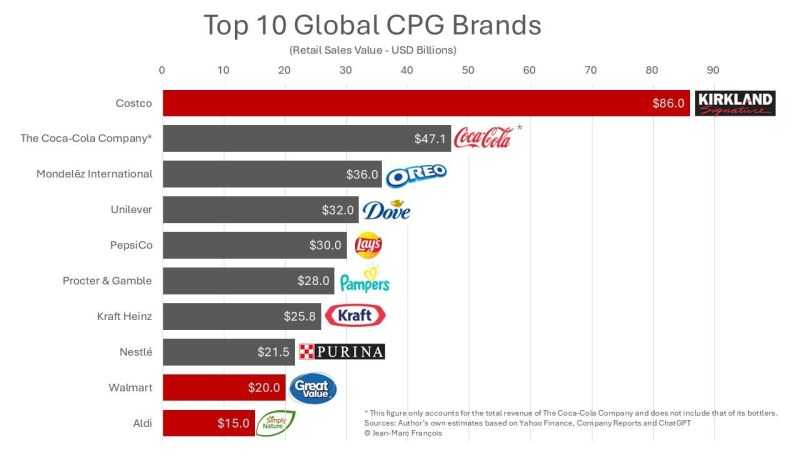
Kirkland vs. Coca-Cola ... Is private label winning?

by Chace Binnie

At first glance, it looks Kirkland is winning, but I wanted to dig deeper into this.

Revenue is only one metric, so I thought: What if they are both winning at different games?

Where Kirkland is winning:

  • They keep the product line simple
  • Every product gets shelf space in Costco
  • They don’t advertise... they let Costco’s reputation do the work
  • It’s efficient to run, with strong margins and low overhead
  • Shoppers trust it because it’s consistent, high quality, and good value

Why Coca-Cola is still doing well:

  • You can buy it literally everywhere... restaurants, stores, stadiums
  • The brand is iconic and instantly recognizable
  • They dominate the beverage aisle with multiple popular products
  • They’re constantly launching new flavors and formats to stay fresh
  • Their marketing connects emotionally... it's more than a drink, it’s a feeling

So which one is winning? Again, it depends on how you look at it.

Jean-Marc François gave his take on CPG's current struggle against private label:
“They’re chasing growth through fragmentation,” Jean-Marc said.

“...in the process, they’re diluting their brand equity.”

Credit to Jean-Marc for this chart of the Top 10 global CPG brands.


Wednesday, 14 May 2025

Tesco’s CEO Says Retail Conditions Have Rarely Been As Tough; Not Planning To Stock US Beef

Tesco CEO Ken Murphy warns that retail trading conditions have “rarely been as tough” (rising costs, red tape, supply chain disruptions, a weak economy).

Speaking at the World Retail Congress in London this week, he pointed to mounting pressures from rising labour costs, as well as increased regulation in areas such as packaging.

The Labour Government has heaped billions of extra costs on retailers via increased National Insurance Contributions, an above-inflation hike in the minimum wage, and higher business rates i.e. warnings of shop closures, job losses.

Murphy: “Things have rarely been as tough for retail as they are today”, highlighting global supply chain disruptions ( via military conflict, trade wars, climate crisis).

Murphy warned: “There is geopolitical instability from the Ukraine to the Red Sea, which will continue to disrupt our supply chains and markets.”
Trump tariffs uncertainties risk upending existing supply chains.

He also highlighted that farmers in its UK supply chain are “under unprecedented strain”.

Meanwhile, days after the UK and US announced a limited trade deal, Murphy revealed that Tesco has no plans to source American beef.
The deal gave US farmers a quota of 13,000 metric tonnes for beef, which meets UK standards, with UK farmers having the same quota for sales into the US.

Speaking to Reuters on the sidelines of the World Retail Congress, Murphy said: “We source 100% Irish and British beef in Tesco and for the foreseeable future that policy will be the same, we’re not planning to change it.”

Last week, US Secretary of Agriculture Brooke Rollins hailed American beef as “the safest, the best quality and the crown jewel of American agriculture” and predicted the trade deal would “exponentially increase” US beef exports to Britain.

However, with little difference between the prices of British-produced beef and US beef that does meet UK standards, industry commentators have suggested that the US product could struggle to find retail buyers in the UK.

NamNews Implications:
  • ‘Retail Conditions Have Rarely Been As Tough’ – agreed 100%+!
  • “But when the going gets tough, the tough get going”, as we used to say (!)
  • Real opportunities for those who act while rivals await evidence of a return to normal.
  • Tesco have made clear their strategy in optimising real market conditions…
  • …and in fact keeping up with Tesco will be a challenge for suppliers.
  • Meanwhile, Tesco's US beef position is significant: (in our opinion)
  • ‘with little difference between the prices of British-produced beef and US beef that does meet UK standards’…
  • …it is unlikely that US Beef will find a UK market.
  • In which case, much depends on the UK government’s determination to resist any attempts to compromise quality standards, under US pressure.
  • Watch this space…
hashtag

Tuesday, 13 May 2025

Sainsbury’s Introduces New Anti-Theft Measure At Self-Service Checkouts

Sainsbury’s has started testing a new security feature on some of its self-service checkouts to combat shoplifting.

The system uses AI-driven video scanning technology to check whether items are scanned properly. When an item is placed in the bagging area without being scanned, the system immediately displays video footage of the incident.

Customers then receive a message saying: “Looks like that last item didn’t scan. Please check you scanned it correctly before continuing.”

Retail sources have described the measure as “a deterrent to shoplifters”.

A spokesperson for Sainsbury’s said: “We regularly review the security measures in our stores and our decisions to implement them are based on a range of factors, including offering our customers a smooth checkout experience.”

NamNews Implications:
  • Much depends on what % of customers are potential shoplifters…
  • i.e. Sainsbury’s have obviously ‘done the sums’…
  • …to balance deterrence vs ‘treating me with suspicion’.
  • Think about a shopper’s succession of ‘didn’t scan’ warnings being seen by neighbouring checkers-out…

Monday, 12 May 2025

Sainsbury’s Testing New Checkout-Free Tech


Sainsbury’s is trialling a new checkout-free system that lets customers pay for their shopping on its SmartShop handsets as part of moves to “reduce friction”.

According to trade publication The Grocer, the supermarket is testing the new payment-enabled devices in its stores in Richmond and Kempston. At the end of their shop, customers tap their card on the SmartShop handset to pay. They can print their receipt at a physical bay or ask for it to be emailed to them.

The SmartShop app, which can be downloaded onto phones, has had a payment function since 2022. However, Sainsbury’s director of future stores and customer experience, Darren Sinclair, told The Grocer that consumer research had found many shoppers preferred to use a physical handset to save their phone battery.

“It’s a bit more ergonomic,” he said. “I think about this as trying to reduce friction, improve payment and simplify the shopping journey, as well as the future potential space.”

Sinclair noted that there are advantages for Sainsbury’s to encourage more shoppers to use the SmartShop facility.

He said: “From a heatmapping perspective, we can see how people shop. We don’t see the physical customer, just see the heat, so we can see which ends are looked at, which screens are looked at and the flow around the store.

“That’s massively insightful when we are working out store formats, or when we are doing Nectar screens for suppliers.”

NamNews Implications:
  • An extra little help for customers…
  • …a major help for Sainsbury’s.
  • And extra insights for suppliers…
  • …all in terms of making every trip count.

Thursday, 8 May 2025

Aldi Seeking Public Input To Find Sites For New Stores

Aldi is calling on the public to help identify the best locations for new stores in the UK.

Customers can submit suggestions for where the discounter should open new outlets, with the most popular areas being considered as part of Aldi’s expansion strategy.

The supermarket currently has more than 1,050 stores and has committed to a long-term goal of operating more than 1,500 sites across the UK.

In the coming months, Aldi will be bringing new stores to areas such as Ashford in Kent, Eastbourne in Sussex, and Caterham in Surrey, as part of its focus on expanding in the South East.

“We’ve always believed that great quality food should be within everyone’s reach and many communities would therefore still benefit from having an Aldi nearby,” said Jonathan Neale, Managing Director of National Real Estate at Aldi UK.

“We’re always looking at key places where we see potential, but we also want to hear directly from the public about where the demand is greatest. Their input is invaluable as we continue to grow and bring Aldi’s unbeatable value to more areas across Britain.”

The supermarket ran a similar initiative last year, which saw locations in London, Manchester, and Derbyshire recognised as priority locations amongst shoppers.

Progress has already been made to bring a new Aldi store to Chesterfield in Derbyshire, with the company recently securing planning for a site on Ringwood Road, Brimington.

To nominate a town or area for consideration, people have to email NextNewStore@aldi.co.uk and state the town they would like to put forward in the subject of the email.

Aldi is asking for submissions by 8th June, with plans to share the results and unveil the next round of priority locations later this year.

NamNews Implications:
  • Aldi will obviously use scientific bases for site selection…
  • …But public support will patently help in securing planning approvals.
  • Besides, one never knows, local support may uncover potential sites missed by the science…
  • Either way, Aldi appears to be determined to achieve their long-term goal of operating more than 1,500 sites across the UK.
  • Watch this space…